

Regenerative fashion: go beyond sustainable for a healthier planet
TL;DR:
- Regenerative fashion actively restores ecosystems and improves communities through sustainable practices.
- It involves farm-level soil health management, innovative manufacturing, and verified supply chains.
- Consumers should look for third-party certifications and transparent data to support genuine regenerative brands.
Sustainable fashion has become the gold standard for eco-conscious shoppers, but it has a ceiling. Reducing harm is not the same as repairing it. While a certified organic cotton shirt avoids pesticides, it does not rebuild the soil that grew it. Regenerative fashion pushes past that ceiling by asking a different question: what if clothing production could actively heal ecosystems, restore biodiversity, and improve the lives of farmers? This guide walks you through exactly what regenerative fashion means, how it works in practice, how it compares to other approaches, and how you can spot and support it with confidence.
Table of Contents
- What is regenerative fashion? A clear definition
- Regenerative practices: How fashion actually heals ecosystems
- Regenerative vs. sustainable fashion: What’s the difference?
- Benefits and challenges of regenerative fashion for consumers and the planet
- How to spot and support regenerative fashion as a consumer
- Why the biggest challenge for regenerative fashion is trust, not technology
- Join the regenerative fashion movement with your next purchase
- Frequently asked questions
Key Takeaways
| Point | Details |
|---|---|
| Net-positive impact | Regenerative fashion aims to heal ecosystems, not just reduce harm. |
| Beyond sustainable labels | Regenerative practices restore soil, boost biodiversity, and support farmer incomes. |
| Consumer verification | Look for traceable supply chains and independent audits to spot legitimate regenerative brands. |
| Industry challenges | Lack of global standards makes greenwashing a risk—do your homework before you buy. |
| Empowered action | Your choices can support brands and systems that truly benefit the planet and people. |
What is regenerative fashion? A clear definition
Most people assume that buying sustainable clothing is the most responsible choice available. That assumption is understandable, but it misses a growing body of thinking that reframes what fashion can actually do for the planet.
“Regenerative fashion is an approach to clothing production and consumption that actively restores ecological systems, soil health, biodiversity, and communities.” — Regenerative fashion overview
Notice the word actively. Sustainable fashion aims to do less damage. Regenerative fashion aims to leave things better than it found them. That is a fundamentally different goal, and it changes everything from how fibers are grown to how garments are disposed of.
The concept draws on regenerative agriculture, a farming philosophy that prioritizes soil biology, water cycles, and ecosystem relationships. When applied to fashion, it means sourcing fibers from farms that use these methods, designing garments for longevity or biodegradation, and ensuring supply chains support fair livelihoods. You can read more in this regenerative fashion research that maps the field in detail.
For eco-conscious consumers, this distinction matters because the fashion industry is responsible for roughly 10% of global carbon emissions. Reducing that number is important, but regenerative fashion asks whether the industry could also sequester carbon, rebuild degraded land, and strengthen rural communities. Our sustainable fashion guide covers the baseline well, but regenerative thinking takes the conversation further.
The key ecological aspects include soil organic matter, water retention, biodiversity above and below ground, and carbon storage. The social dimension covers fair wages, land rights, and community resilience. Together, these create a net-positive impact rather than a net-neutral one.
Regenerative practices: How fashion actually heals ecosystems
Knowing the definition is one thing. Understanding how it works on the ground is where the concept becomes real.
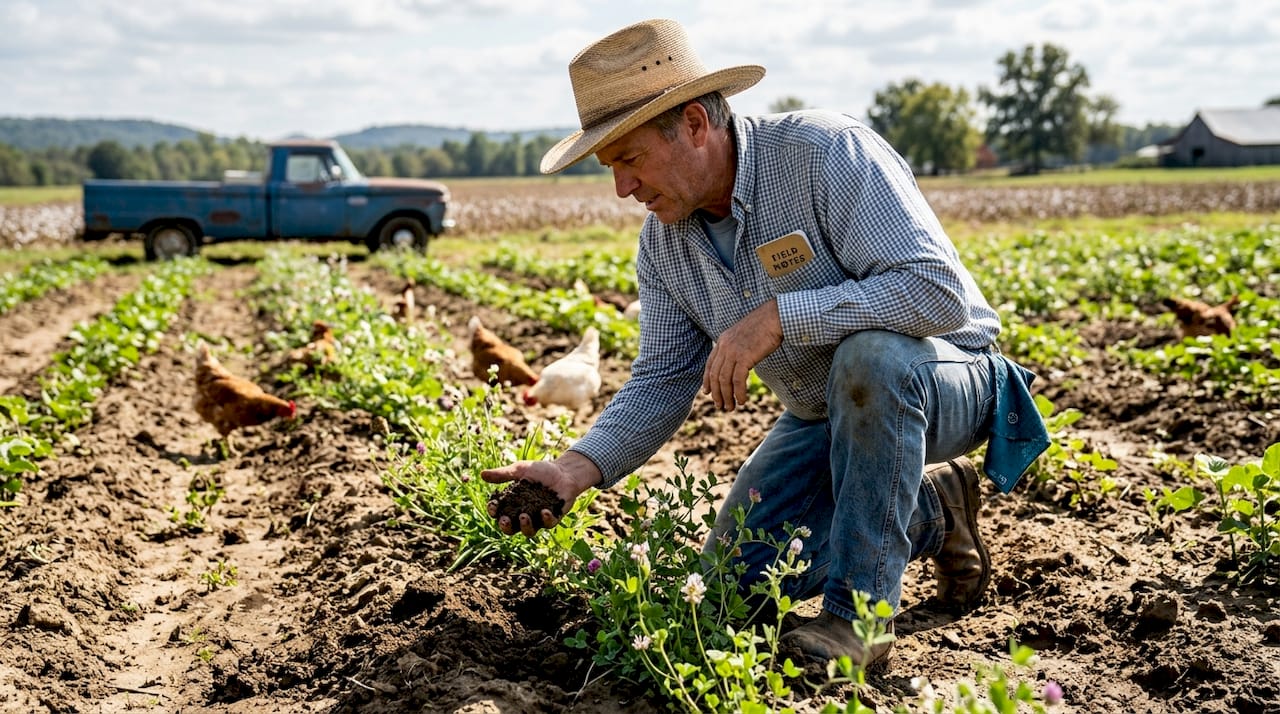
At the farm level, regenerative practices include cover cropping, rotational grazing, minimal soil disturbance, integrated pest management, agroforestry, and composting. These methods rebuild soil biology, reduce erosion, and increase the land’s ability to hold water and carbon. A cotton field managed regeneratively looks and behaves very differently from a conventional one.
Beyond the farm, regenerative fashion extends into manufacturing. Closed-loop systems, natural dyes, mycelium leather, and biodegradable packaging all reduce the toxic footprint of production. The goal is that every stage of a garment’s life either restores or returns to natural cycles without leaving harmful residue.
Top regenerative practices in fashion:
- Cover cropping and crop rotation to rebuild soil nutrients
- Rotational grazing for fiber animals like sheep and alpacas
- Agroforestry that integrates trees with fiber crops
- Closed-loop manufacturing with zero-waste design
- Natural and plant-based dyes that biodegrade safely
- Mycelium and other bio-based material innovations
- Local and traceable supply chains with verified farmer partnerships
| Practice | Sustainable fashion | Regenerative fashion |
|---|---|---|
| Soil management | Avoids degradation | Actively rebuilds soil biology |
| Water use | Reduces consumption | Improves watershed function |
| Biodiversity | Limits harm | Enhances species diversity |
| Carbon | Lowers emissions | Sequesters carbon in soil |
| Supply chain | Certified, traceable | Farmer-partnered, place-specific |
| End of life | Recyclable or durable | Biodegradable or circular |
As practices documented in research confirm, the combination of cover cropping, agroforestry, and closed-loop manufacturing creates measurable ecosystem improvements that standard sustainability certifications do not require.
Pro Tip: When evaluating a brand’s regenerative claims, ask specifically about digital product passports and third-party farm audits. These tools create a verifiable paper trail from soil to shelf. You can also check sustainable apparel trends and our ethical fashion guide for brands already moving in this direction.
Regenerative vs. sustainable fashion: What’s the difference?
The fashion industry loves a buzzword, and “regenerative,” “sustainable,” and “circular” are now used almost interchangeably. They are not the same thing.
| Approach | Core aim | Key methods | Outcome |
|---|---|---|---|
| Sustainable | Reduce harm | Organic certification, water savings | Less damage |
| Circular | Close material loops | Recycling, take-back programs | Less waste |
| Regenerative | Restore ecosystems | Regenerative agriculture, biodegradable design | Net-positive impact |
As research comparing these approaches makes clear, sustainable fashion reduces harm while regenerative fashion actively improves systems. Circular fashion sits in between, but it has real limitations: recycled materials degrade in quality over time, and recycling alone does not restore a single acre of depleted farmland.
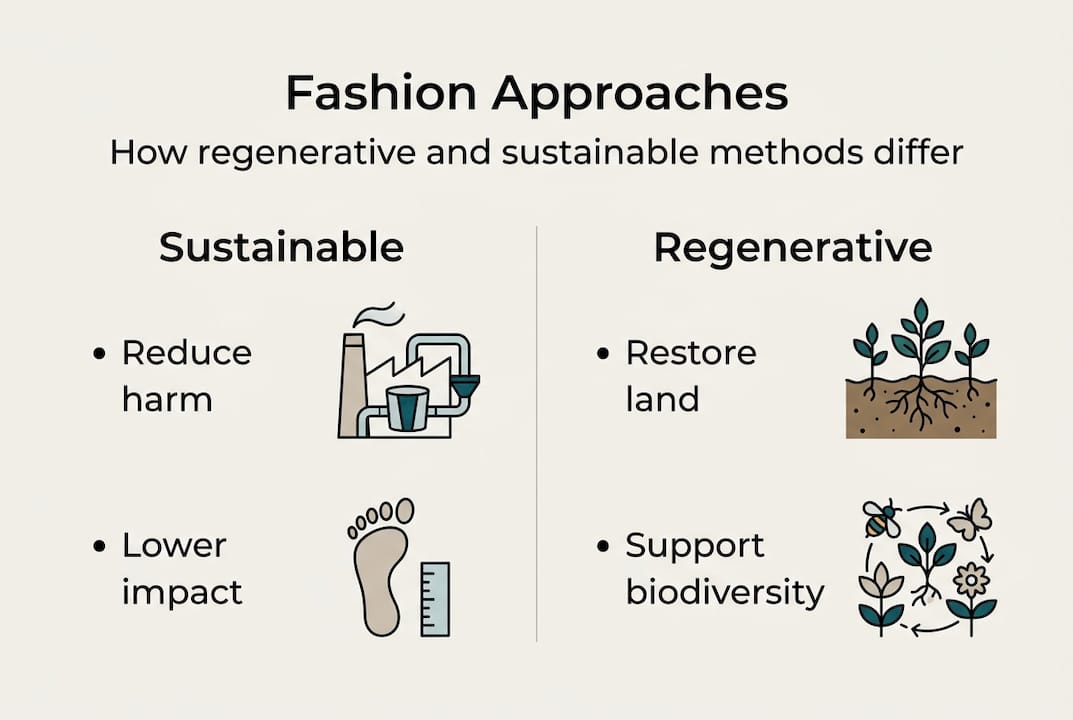
The difference in approaches also shows up in how brands communicate. Sustainable brands highlight certifications like GOTS or Fair Trade. Regenerative brands ideally provide farm-level data, soil test results, and farmer income reports.
How to spot each approach when shopping:
- Look for GOTS, Fair Trade, or bluesign certification for sustainable claims
- Check for take-back or recycling programs for circular claims
- Ask for soil health data, farm partnerships, or Regenagri certification for regenerative claims
- Search for digital product passports that trace the garment back to the field
- Read the brand’s sourcing page, not just its marketing copy
For a practical breakdown of what to wear and why it matters, our sustainable outfits guide is a useful companion resource.
Benefits and challenges of regenerative fashion for consumers and the planet
The case for regenerative fashion is compelling, but it is not without complications. Understanding both sides helps you make smarter choices.
Key benefits:
- Improved soil organic matter and long-term land fertility
- Carbon sequestration that actively fights climate change
- Greater water retention and reduced flood and drought risk
- Increased biodiversity in farming landscapes
- Stronger livelihoods for farmers and rural communities
- Supply chains more resilient to climate shocks
The numbers behind these benefits are striking. Regenerative agriculture in fashion can produce 20% more soil carbon compared to conventional methods, and farmers working with regenerative brands often earn income premiums of 30 to 50% above market rates. That is not a marginal improvement. It is a structural shift in how value flows through the supply chain.
Real-world evidence supports this. Regenerative agriculture outcomes show measurable gains in biodiversity and soil health on farms that have adopted these methods, and regenerative cotton projects are already translating these farm gains into finished garments.
However, the challenges are real. Higher production costs often translate to higher retail prices, which limits access. More critically, there is no universal definition of regenerative fashion, which means the label can be applied loosely. Only 11 of the top 50 fashion firms have set targets aligned with credible regenerative agriculture standards, leaving most claims unverified.
For European consumers, the practical path forward is to support brands that use third-party verification, ask hard questions about sourcing, and use your purchasing power as a signal. Our ethical fashion step-by-step guide walks through exactly how to do that.
How to spot and support regenerative fashion as a consumer
Enthusiasm for regenerative fashion is growing fast, but the tools to verify it are still catching up. Here is how to navigate that gap.
What to look for when shopping:
- Regenagri, NATIVA, or Fibershed certification on fiber sourcing
- QR codes or digital passports linking to farm-level data
- Named farm partnerships with published soil or biodiversity reports
- Context-specific claims tied to a real place and farming system
- Transparent pricing that explains the cost of regenerative inputs
As guidance on verifying regenerative claims confirms, traceable supply chains and third-party audits are the most reliable indicators that a brand’s regenerative label reflects real practice. Vague statements about “nature-positive” sourcing without documentation are a warning sign.
Initiatives like NATIVA (regenerative wool from South America), Regenagri (a global certification program), and Fibershed (regional fiber systems in the US and Europe) represent the leading edge of verified regenerative supply chains. Look for these names when researching brands.
The regenerative supply chain work happening in cotton is a good example of what credible documentation looks like: farm audits, soil tests, and income data published alongside the product.
Pro Tip: Before buying, search the brand name plus “regenerative” and “audit” or “certification.” If nothing comes up beyond marketing copy, that tells you something important. Our fashion ethics guide also lists the questions worth asking any brand directly.
Beyond individual purchases, amplifying impact means buying less overall, choosing pieces designed to last, and asking brands publicly about their sourcing. Consumer pressure has historically driven more industry change than regulation alone.
Why the biggest challenge for regenerative fashion is trust, not technology
The farming methods exist. The materials science is advancing quickly. The supply chain models are being tested and refined. So why is regenerative fashion still a niche concept rather than the industry standard?
The honest answer is that trust is the missing ingredient, not technology. Brands have discovered that “regenerative” resonates with conscious consumers, and some are using it as a marketing term without the substance to back it up. The result is a credibility gap that makes it harder for genuinely committed brands to stand out.
No universal certification standard means the word “regenerative” can be applied to almost anything, and most consumers lack the tools to tell the difference. That is not a technology problem. It is a transparency problem.
We believe the most powerful thing you can do right now is develop your own critical literacy as a consumer. Read sourcing pages. Ask for data. Reward brands that publish uncomfortable truths alongside their achievements. Our sustainable fashion explained resource is a good starting point for building that knowledge base.
Until global standards catch up, your skepticism is not cynicism. It is the most effective tool for driving real change in the industry.
Join the regenerative fashion movement with your next purchase
Understanding regenerative fashion is the first step. Acting on it is where the real impact begins. The good news is that choosing better does not require a complete wardrobe overhaul.

At m23.store, we curate clothing made with transparency, ethical production, and environmental responsibility at the core. From certified organic materials to fair labor practices in Berlin and Poland, every piece is chosen with your values in mind. Explore our collections and read our sustainable trends 2026 guide to find pieces that align with where fashion is heading. Small, informed choices add up to real change.
Frequently asked questions
How does regenerative fashion differ from sustainable fashion?
Regenerative fashion goes beyond reducing harm to actively restore ecosystems and communities, while sustainable fashion reduces harm without necessarily improving the systems it touches.
Can consumers verify if a brand is truly regenerative?
Yes. Look for traceable supply chains and third-party certifications like Regenagri or NATIVA that document regenerative practices at the farm level.
Are regenerative fashion products more expensive?
Often, yes. Higher production costs and income premiums for farmers can raise prices, but those costs reflect genuine ecological and community investment.
Are there risks of greenwashing in regenerative fashion?
Absolutely. The lack of a universal standard means brands can misuse the label freely, so independent verification and consumer scrutiny remain essential.