

Green fashion's real impact: what shoppers must know
TL;DR:
- Genuine green fashion assesses the entire supply chain, not just using eco-friendly labels.
- Accurate impact measurement relies on tools like LCA, Higg Index, and transparent certifications.
- Consumer skepticism and demand for transparency are essential to combat greenwashing and promote real sustainability.
Many fashion brands plaster words like “sustainable” and “eco-friendly” across their labels, but the reality behind those claims is far more complicated. Green fashion done right goes well beyond choosing organic cotton or slapping a recycled logo on a tag. It means scrutinizing the full supply chain, from raw material sourcing to end-of-life disposal, and demanding transparency at every step. For eco-conscious shoppers across Europe, understanding what authentic green fashion actually means isn’t just helpful — it’s essential. This guide breaks down the real environmental and social stakes, the tools you can use to measure impact, the regulatory landscape reshaping the industry, and how to spot misleading claims before they mislead you.
Table of Contents
- Understanding green fashion: More than just a label
- The measurable impact: Data, benchmarks, and tools
- Policy, regulation, and the European context
- Greenwashing, certifications, and making informed choices
- Why true green fashion impact demands consumer skepticism
- Explore sustainable options for your wardrobe
- Frequently asked questions
Key Takeaways
| Point | Details |
|---|---|
| Impact requires evidence | Truly green fashion is defined by measurable reductions in energy use, water, and emissions, not just marketing claims. |
| Certifications are critical | Focus on LCA-backed tools and robust EU-aligned certifications for trustworthy sustainable fashion shopping. |
| Beware greenwashing | Over half of brands exaggerate or misrepresent their green credentials—always verify claims and evidence. |
| European policy shapes progress | EU strategies and new rules drive change, but real impact depends on smarter shopping and production shifts. |
| Durability is not a fix-all | Lasting clothes matter, but reducing consumption is essential for sustainable impact. |
Understanding green fashion: More than just a label
When you hear “green fashion,” your mind probably jumps to organic cotton or a jacket made from recycled plastic bottles. Those are good starts, but they barely scratch the surface. Genuinely sustainable fashion considers every stage of a garment’s life: growing or producing raw fibers, spinning and weaving, dyeing and finishing, cutting and sewing, shipping, retail, consumer care, and final disposal. A brand can use organic cotton and still run factories with exploitative wages or toxic chemical runoffs.
The fashion industry’s sustainability data is sobering: fashion accounts for 2 to 8% of global CO2 emissions, produces 20% of industrial wastewater, consumes 215 trillion liters of water per year, and sends 85% of textiles to landfill. Switching to recycled inputs and renewable energy alone can cut greenhouse gas emissions by up to 48%.
“The fashion industry uses more energy than aviation and shipping combined. The scale of the problem demands more than isolated green choices — it demands systemic accountability.”
Authentic green fashion covers eco-friendly textiles and much more. Here’s what it genuinely looks like:
- Certified materials: Organic, recycled, or bio-based fibers with verified third-party certification
- Ethical labor: Fair wages, safe conditions, and no child or forced labor throughout the supply chain
- Low-impact production: Minimized water use, reduced chemical inputs, and renewable energy sourcing
- Circular design: Products built to last, be repaired, and eventually be recycled or composted
- Transparent supply chains: Brands that openly disclose factory locations, audits, and material origins
- Proximity manufacturing: Shorter supply chains that cut transport emissions and allow closer oversight
Certifications vary enormously in strength. GOTS (Global Organic Textile Standard) and OEKO-TEX cover materials and processing but not always labor. B Corp certification looks at the whole business. Meanwhile, vague terms like “eco collection” or “conscious line” carry no regulated meaning whatsoever. Understanding the difference between robust certifications and marketing language is the first practical skill every conscious shopper needs. Exploring the range of sustainable fabric types can help you build that skill quickly.
The measurable impact: Data, benchmarks, and tools
Feeling strongly about sustainability is one thing. Measuring it is another. The good news is that serious tools now exist to evaluate green fashion’s real-world impact with data, not just good intentions.
Life Cycle Assessment, or LCA, is the gold standard methodology. It maps every input and output across a garment’s entire life, from fiber production through washing and disposal, and translates them into environmental impact scores. LCA-based evaluation is often paired with microfiber emission assessments and scenario analyses, giving researchers and brands a rigorous picture of real impact. Other key tools include the Higg Index, developed by the Sustainable Apparel Coalition, and the Materials Sustainability Index (MSI), which benchmarks raw materials from cotton to nylon.
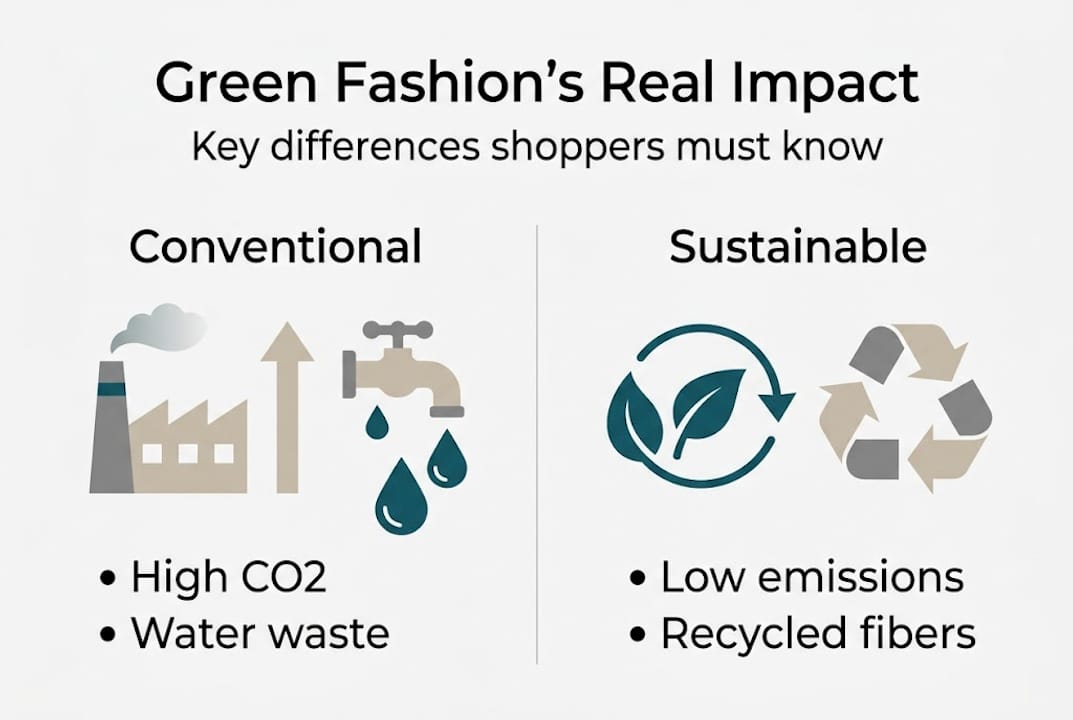
Here’s a simplified comparison of how production models stack up:
| Production model | CO2 impact | Water use | End-of-life score |
|---|---|---|---|
| Fast fashion (linear) | Very high | Very high | Poor (landfill) |
| Conventional with certifications | Moderate | Moderate | Fair |
| Circular (recycled + local) | Low | Low | Good (recyclable) |
| Circular + renewable energy | Very low | Very low | Excellent |
Circular approaches, those that recycle fibers, use renewable energy, and manufacture closer to market, deliver the biggest gains. At just a 10% recycling rate across the EU, studies estimate 440,000 tonnes of CO2 equivalent saved and 8.8 billion cubic meters of water conserved annually, according to textile impact data.
So how can you, as a shopper, actually use these tools? Follow these steps:
- Ask for LCA disclosure: Brands increasingly publish product-level LCA summaries. If they don’t, ask why.
- Check Higg Index scores: A score above 70% signals strong material performance. Look for this on brand websites or third-party databases.
- Use brand transparency indexes: Tools like the Fashion Transparency Index rate brands on supply chain disclosure.
- Look for A-E EU labeling (coming soon): The EU is proposing standardized environmental labeling similar to energy labels on appliances.
- Compare product categories: A recycled polyester jacket will always score differently from a virgin wool sweater. Context matters.
Want a deeper orientation? The full breakdown in sustainable fashion explained gives a strong starting point for reading these signals confidently.
Policy, regulation, and the European context
Europe is setting the pace globally when it comes to regulating fashion’s environmental impact. The EU Strategy for Sustainable and Circular Textiles, adopted in 2022, sets binding targets for 2030, including requirements that all textiles sold in the EU be durable, repairable, and recyclable. Separate textile collection systems became mandatory across EU member states in January 2025. The EU is also working on Digital Product Passports to give consumers traceable information about a garment’s origins and materials.

The circular textiles strategy is genuinely ambitious, but it carries one important blind spot: it focuses heavily on durability and recyclability without directly tackling the volume of clothing being produced and consumed. Current textile recycling rates sit below 1%, with a target of 26% by 2030. Getting there requires enormous investment in sorting and processing infrastructure.
Here’s a quick comparison of policy approaches:
| Approach | Focus | Limitation |
|---|---|---|
| Linear regulation | Waste management | Treats symptoms, not causes |
| Durability standards | Product lifespan | Doesn’t cap production volume |
| Circular economy targets | Recycling and repair | Infrastructure still underdeveloped |
| Extended Producer Responsibility | Brand accountability | Variable enforcement across EU states |
As a European consumer, here’s what to watch for when assessing brand compliance:
- Does the brand publish its carbon reduction roadmap aligned with EU 2030 targets?
- Is there a documented take-back or repair program?
- Does the brand disclose factory locations and audit results?
- Are materials certified under EU-recognized standards like GOTS or OEKO-TEX?
- Is the brand preparing for Digital Product Passport requirements?
Pro Tip: Third-party certifications aligned with EU strategies, such as the EU Ecolabel, carry more regulatory weight than brand-created green labels. Look for them on product pages and packaging.
Understanding fashion ethics and staying current with sustainable apparel trends can help you stay ahead of these fast-moving changes.
Greenwashing, certifications, and making informed choices
Greenwashing is the practice of making misleading or exaggerated environmental claims to attract conscious consumers without backing them up with real action. It’s rampant in fashion. Greenwashing research across European brands found that 53% of green claims are vague or misleading, and 40% lack any supporting evidence. The EU Green Claims Directive, designed to crack down on this, is still working through legislative delays.
Fast fashion brands have become particularly skilled at using influencer marketing and social media to make consumers feel virtuous about purchases that carry no meaningful environmental benefit. A celebrity wearing a “sustainable capsule collection” from a brand that produces 100 million garments a year doesn’t add up.
“A brand can certify a single product and market it as a green brand. That’s not sustainability — that’s selective transparency.”
Common greenwashing tactics to watch for:
- Vague language: Words like “eco,” “green,” “natural,” or “responsible” with no supporting evidence
- Cherry-picked certifications: One certified product used to brand an entire uncertified range
- Irrelevant claims: Highlighting an attribute that is legally required or industry standard anyway
- Hidden trade-offs: Promoting recycled packaging while ignoring harmful production processes
- Carbon offset deflection: Using offset programs to claim “carbon neutral” without reducing actual emissions
Evaluating certifications takes practice. GOTS and OEKO-TEX 100 are strong for materials. Fair Trade focuses on labor. B Corp covers overall business ethics. Certifications that exist only on a brand’s own website, without a publicly searchable verification database, should raise immediate flags.
Pro Tip: Ask brands directly for LCA documentation or Higg Index scores. Brands with nothing to hide will share them. Those who can’t produce the evidence likely don’t have it.
Learning about sustainable sourcing and understanding why you might want to shop sustainable online can sharpen your ability to separate honest brands from clever marketers.
Why true green fashion impact demands consumer skepticism
Here’s the uncomfortable truth that most green fashion guides won’t tell you: buying a durable, certified, LCA-verified jacket is a good choice, but it doesn’t automatically make your wardrobe sustainable if you’re still buying 30 new pieces a year. Durability alone doesn’t cut total consumption. Studies show a 92% likelihood that recycling-based production reduces climate impact, yet critics point out that a longer-lasting garment doesn’t stop many consumers from buying just as frequently anyway. This is called the behavioral rebound effect.
Green marketing is exceptionally good at making you feel better without asking you to buy less. That’s not an accident. The fashion industry profits from volume, and even sustainable brands face pressure to grow. Real impact comes from combining smarter material choices with deliberate consumption habits: buying fewer pieces, caring for what you own, repairing before replacing.
“The most sustainable garment is the one already in your closet. Every new purchase, however certified, carries an environmental cost.”
Consumer skepticism isn’t cynicism. It’s the most powerful tool available to you. Ask hard questions, demand transparent evidence, and recognize that brands, policymakers, and you share the responsibility. Explore eco-conscious wardrobe essentials for a practical look at building a wardrobe that actually reflects your values.
Explore sustainable options for your wardrobe
If you’re ready to move beyond claims and put your values into action, m23.store offers a curated selection of fashion built on transparency, ethical production in Berlin and Poland, and materials that meet rigorous environmental standards.

Every piece is designed for durability, not disposability, using certified organic and recycled materials with supply chain accountability you can actually verify. Whether you’re building a capsule wardrobe or looking for one well-made piece that lasts a decade, the collection reflects what genuinely green fashion should look like. Start by exploring eco-friendly fabrics to understand exactly what goes into each garment before you decide.
Frequently asked questions
How does green fashion actually reduce environmental impact?
Green fashion cuts emissions and water use primarily through circular practices like fiber recycling and proximity manufacturing. At a 10% EU recycling rate, studies estimate 440,000 tonnes CO2e saved and 8.8 billion cubic meters of water conserved each year.
What are the most trustworthy green fashion certifications?
GOTS, OEKO-TEX, and LCA-backed Higg Index scores above 70% offer the most robust, independently verified evidence of genuine environmental performance.
How can I tell if a brand is greenwashing?
Look for vague language, missing evidence, and influencer-heavy marketing. 53% of green claims by European brands are unsubstantiated, so always ask for certification databases or LCA documentation.
Why is durability not always enough to make fashion sustainable?
Longer-lasting products reduce waste, but the behavioral rebound effect means consumers often keep purchasing at the same rate regardless. Durability must be paired with reduced overall consumption to make a real difference.
What role does recycling play in sustainable fashion?
Recycling saves energy, reduces landfill pressure, and cuts emissions significantly, but textile recycling currently sits below 1% in Europe. The EU has set a target of 26% by 2030, which will require major investment in sorting and processing infrastructure.