

Socially responsible fashion: a guide to ethical choices
TL;DR:
- True social responsibility combines fair wages, safe conditions, and eco-friendly materials.
- Recognize certified brands through third-party labels like GOTS, Fairtrade, and Fair Wear Foundation.
- Industry still faces challenges like overproduction, low transparency, and greenwashing efforts.
Many shoppers assume that buying organic cotton or recycled materials automatically means they’re supporting a fair, ethical brand. That’s a costly misconception. A garment can be made from certified eco-friendly fabric and still be sewn by workers earning poverty wages in unsafe conditions. Socially responsible fashion covers both ethical labor practices and environmental sustainability together, not one or the other. This guide helps you understand what genuine social responsibility looks like in fashion, how to spot brands that actually walk the talk, and why the gap between green marketing and real accountability is wider than most people think.
Table of Contents
- What does socially responsible fashion mean?
- How to recognize socially responsible brands
- Current industry benchmarks and challenges
- Socially responsible fashion in practice: European examples and edge cases
- Why true social responsibility means demanding more than a green label
- Make responsible fashion part of your everyday
- Frequently asked questions
Key Takeaways
| Point | Details |
|---|---|
| Meaning of socially responsible fashion | It combines ethical treatment of workers with strong environmental standards in every stage of production. |
| Identifying responsible brands | Genuine brands provide third-party certifications and transparent supply chain audits so you can shop with confidence. |
| Industry challenges remain | Overproduction, weak policy, and greenwashing are slowing progress—so look beyond just eco-labels. |
| European leadership and innovation | European initiatives set strong examples but require ongoing policy improvement to protect both people and the planet. |
| Consumer action matters | Your conscious choices can help close the gap between good intentions and real impact in fashion. |
What does socially responsible fashion mean?
Socially responsible fashion is not just about swapping polyester for organic cotton. It’s a broader commitment that holds brands accountable for how they treat people and the planet across every step of production. That means fair wages, safe working conditions, a strict ban on child labor, and materials that don’t poison waterways or accelerate climate change.
The confusion between “green” and “fair” is real and worth addressing directly. A brand can invest heavily in biodegradable packaging while its factory workers earn less than a living wage. Conversely, a brand might pay workers well but still rely on synthetic, petroleum-based textiles. True social responsibility demands both. Understanding ethical apparel principles helps you see why neither side of this equation can be ignored.
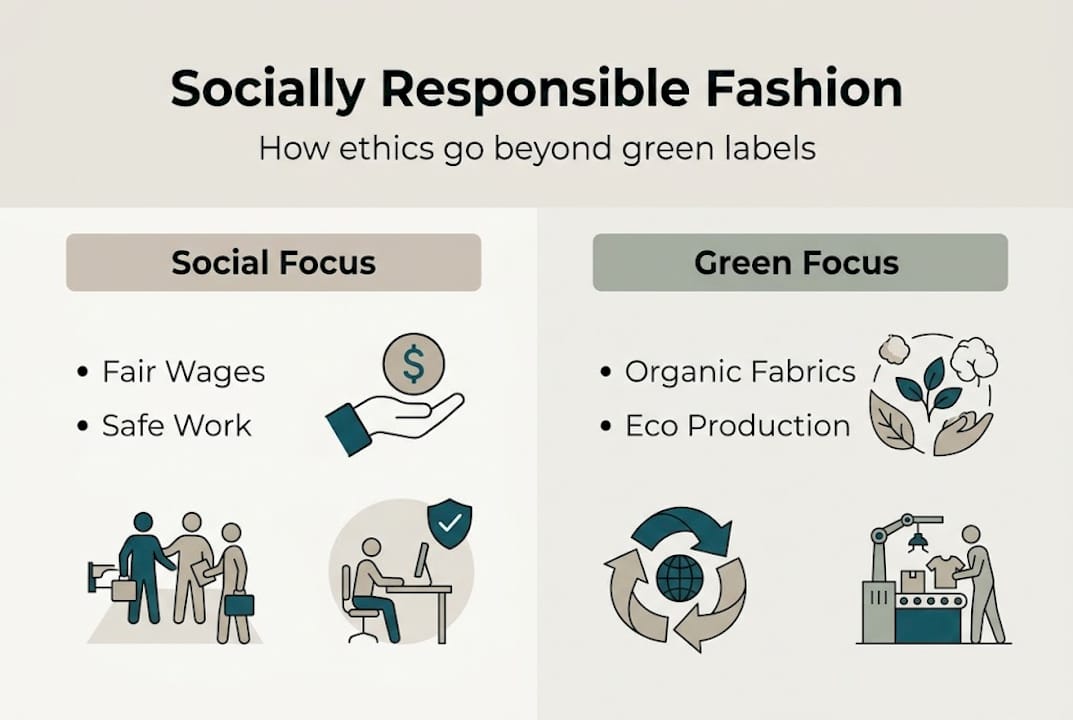
The difference between ethical and sustainable fashion is subtle but important. Sustainable fashion typically centers on environmental impact, while ethical fashion focuses on human rights. Socially responsible fashion is the intersection of both.
Here’s a quick snapshot of what socially responsible fashion actually covers:
- Fair wages: Workers earn at least a living wage, not just the legal minimum
- Safe conditions: Factories meet international safety standards with regular audits
- No child or forced labor: Zero tolerance, verified by third parties
- Eco-friendly materials: Certified organic, recycled, or low-impact textiles
- Supply chain transparency: Named factories, published audit results, traceable sourcing
- Reduced environmental footprint: Lower emissions, water use, and chemical waste
“Socially responsible fashion emphasizes ethical labor practices including fair wages, safe working conditions, and no child labor, alongside environmental sustainability through eco-friendly materials and reduced-impact production.”
When a brand checks all these boxes consistently, not just in its marketing copy, that’s when you’re looking at the real thing.
How to recognize socially responsible brands
Knowing the definition is one thing. Spotting it in the wild is another. The most reliable shortcut is third-party certification. Certifications like GOTS, Fairtrade, and Fair Wear Foundation exist precisely because brand self-claims are easy to make and hard to verify.
Key certifications include GOTS for organic textiles with social criteria, Fairtrade for labor standards, and Fair Wear Foundation audits specifically designed for European brands. Here’s how they compare:
| Certification | Focus area | Covers labor? | Covers environment? |
|---|---|---|---|
| GOTS | Organic textiles | Yes (social criteria) | Yes |
| Fairtrade | Supply chain fairness | Yes | Partially |
| Fair Wear Foundation | Factory labor audits | Yes | No |
| B Corp | Business-wide ethics | Yes | Yes |
Beyond certifications, look for brands that name their factories publicly, share audit results, and explain their supply chain in plain language. Vague statements like “we care about people and the planet” without supporting evidence are a red flag. Real transparency is specific and uncomfortable sometimes, because it acknowledges where a brand still needs to improve.

Greenwashing is the practice of using eco-friendly imagery or language to mask poor labor or environmental practices. It’s widespread. A brand might launch a “conscious collection” using 5% recycled material while the rest of its line remains unchanged. Learning what makes fashion ethical gives you the framework to push past surface-level claims.
Pro Tip: When a brand holds a third-party certification, it means an independent body has audited its claims. When a brand only cites its own reports or internal standards, treat those claims with healthy skepticism.
Here’s a practical checklist before you buy:
- Search the brand’s website for named factory locations
- Check if they hold GOTS, Fairtrade, or Fair Wear Foundation certification
- Look for published audit results or annual impact reports
- Read the sustainable fashion explained breakdown to compare claims
- Check independent review platforms or brand rating apps like Good On You
Using this ethical fashion guide alongside your own research gives you a much stronger foundation for every purchase decision.
Current industry benchmarks and challenges
The fashion industry’s record on social and environmental responsibility is, frankly, poor. Fashion generates 8 to 10% of global carbon emissions, and only 3 out of 42 major companies are currently on track to meet 1.5°C climate targets. Most major brands score low on circularity, meaning they still design products that end up in landfills.
Here’s a snapshot of where the industry stands:
| Area | Current status | Industry target |
|---|---|---|
| Carbon emissions | 8 to 10% of global total | 45% reduction by 2030 |
| Brands on track for 1.5°C | 3 out of 42 | All major brands |
| Circular fashion adoption | Low across most brands | Mainstream by 2030 |
| Supply chain transparency | Below 50% disclosure | Full traceability |
The circular economy model, where clothes are designed to be reused, repaired, or recycled rather than discarded, is often cited as the solution. But the circular fashion benchmark shows that while circular fashion is growing, it is still far from mainstream scale. Most brands lag because circularity requires rethinking design, logistics, and business models from the ground up.
Exploring sustainable apparel trends reveals how some forward-thinking brands are beginning to close this gap, but systemic barriers remain. Overproduction is the biggest one. Brands producing thousands of new styles per year cannot credibly claim to be responsible, regardless of the materials used.
Here are the major hurdles holding the industry back:
- Overproduction: Fast fashion volumes make waste inevitable
- Lack of transparency: Most brands still don’t disclose full supply chains
- Policy gaps: Voluntary commitments without enforcement rarely deliver change
- Consumer pressure limitations: Individual choices matter but can’t substitute for regulation
- Greenwashing at scale: Marketing budgets outpace genuine reform efforts
Choosing brands that use organic materials is one meaningful step, but it only addresses part of the problem. The structural issues require both smarter consumer choices and stronger policy frameworks.
Socially responsible fashion in practice: European examples and edge cases
Europe has some of the most advanced frameworks for responsible fashion globally. European initiatives like Fair Wear and Ethical Fashion Initiative focus on social integration, artisan skills, and migrant worker inclusion. But even these well-intentioned programs acknowledge that voluntary reforms are often insufficient without binding regulation.
Brands certified by Fair Wear Foundation, for example, must undergo factory audits and publish their results. That’s a higher bar than most. The Ethical Fashion Initiative works with artisan communities in Africa and Asia to ensure fair pay and skills development, connecting marginalized producers to European markets. These are real, measurable efforts.
European supply chains often carry higher labor standards by default, because EU labor law sets a stronger floor than many producing countries. Brands manufacturing in Berlin, Portugal, or Poland operate under stricter worker protections than those sourcing from regions with weaker enforcement. That’s one reason local production is often a meaningful signal of genuine responsibility.
But edge cases exist. Watch for these red flags:
- Self-certification: A brand claiming its own “ethical standard” without third-party verification
- Partial transparency: Publishing some factory names but not others, especially for high-risk tiers
- Circular marketing without circular practice: Promoting a take-back program that handles less than 1% of total output
- Vague sustainability targets: “We aim to reduce emissions” without a baseline, timeline, or method
- Artisan washing: Using images of craftspeople to imply fairness without disclosing wages or conditions
Pro Tip: When a brand promotes slow or circular fashion heavily in its marketing, ask what percentage of its total production that actually represents. A small capsule collection does not make a brand responsible.
Exploring regenerative fashion shows what the most ambitious brands are doing beyond sustainability, actively restoring ecosystems and communities rather than just reducing harm. That’s the direction the industry needs to move. Understanding what sustainable fashion means in practice, beyond the buzzwords, is essential for any conscious shopper.
Why true social responsibility means demanding more than a green label
Here’s an uncomfortable truth: most brands marketed as responsible are not responsible enough. Eco-materials are important, but they cannot offset exploitation or runaway overproduction. A brand releasing 500 new styles per season using organic cotton is still contributing to the overconsumption problem at its core.
True responsibility requires systemic change beyond materials and labor to circular models, because overproduction undermines every positive effort a brand makes. This is the part most brand communications skip entirely.
Voluntary commitments have their place, but they have clear limits. The brands making the most noise about sustainability are often the ones with the most to hide. Real progress comes from binding regulation, mandatory supply chain disclosure, and extended producer responsibility laws that make brands financially accountable for their waste.
As a conscious consumer, your most powerful move is not just buying better. It’s demanding better, publicly. Support brands that publish uncomfortable truths about their own shortcomings alongside their wins. Use the deeper ethical fashion guide to hold brands to a higher standard. And recognize that your purchasing choices, multiplied across millions of European consumers, send a signal that markets and policymakers cannot ignore.
Make responsible fashion part of your everyday
You now have the tools to move past green labels and ask the right questions. Start with one intentional purchase, a piece that carries a verified certification, comes from a transparent supply chain, and is built to last.

At M23, we’ve built our entire collection around exactly these principles: certified organic and recycled materials, fair production in Berlin and Poland, and full transparency about how and where our clothes are made. Browse our range to find pieces that align with your values, and check our sustainable outfits guide for practical inspiration on building a wardrobe you can feel genuinely good about.
Frequently asked questions
What is an example of a socially responsible fashion brand?
A socially responsible fashion brand uses certified organic materials, guarantees fair wages and safe labor conditions, and publishes transparent supply chain audits. Brands holding Fair Wear Foundation certification are among the most rigorously verified examples available to European consumers.
How does socially responsible fashion differ from sustainable fashion?
Socially responsible fashion covers both workers’ rights and environmental impact together, while sustainable fashion often focuses more on eco-friendly materials and production practices without always addressing labor conditions.
What certifications should I look for in responsible fashion?
Look for GOTS for organic textiles with social criteria, Fairtrade for supply chain labor standards, and Fair Wear Foundation for factory-level labor audits. These three certifications together cover the broadest range of social and environmental standards.
Why is transparency important in socially responsible fashion?
Transparency lets you verify that a brand’s ethical claims are backed by real evidence. Brands that publish named factories and independent audit results give you something concrete to evaluate, rather than marketing language alone.
Is circular fashion always socially responsible?
Not automatically. Circular fashion reduces material waste, but a brand must also meet strong labor and social standards to be truly responsible. Circular models alone don’t guarantee fair wages, safe conditions, or genuine supply chain accountability.