

Why shop organic apparel? Real benefits for conscious buyers
Organic cotton uses up to 91% less irrigation water and produces 45% fewer CO2 emissions per hectare than conventional cotton. That’s not a marketing claim—it’s measurable, verified data. Yet millions of shoppers still assume organic apparel is just a premium label with little real-world impact. This guide cuts through the noise and walks you through the environmental, health, and ethical reasons why choosing organic clothing is one of the most meaningful decisions you can make as a consumer. Whether you’re shopping for yourself or your kids, the facts here will change how you look at your wardrobe.
Table of Contents
- What makes apparel organic?
- Major environmental benefits of organic apparel
- Health and safety for families
- Ethics, fairness, and true cost comparisons
- Caveats and real-world nuance: Is organic always best?
- How to shop for organic apparel: Tips and action steps
- Eco-friendly style starts with you
- Frequently asked questions
Key Takeaways
| Point | Details |
|---|---|
| Verified organic is impactful | Certified organic apparel truly reduces water use, emissions, and supports environmental health. |
| Safe for sensitive skin | Organic clothing minimizes chemical exposure for babies, children, and those with allergies. |
| Fair and ethical production | GOTS and Fairtrade certifications protect workers, ban child labor, and ensure fair wages. |
| Not all organic is equal | Assess certifications and context; recycled options sometimes offer more sustainable choices. |
| Smart shopping is possible | Consumers can use certifications, labels, and transparency to choose genuinely organic apparel. |
What makes apparel organic?
Organic apparel starts in the field. The cotton or other natural fiber must be grown without synthetic pesticides, herbicides, or genetically modified seeds. That’s the agricultural foundation. But the term “organic” only holds real weight when it’s backed by a recognized certification.
The most trusted standard globally is GOTS, which stands for Global Organic Textile Standard. GOTS certification covers the entire supply chain, from harvest through spinning, dyeing, sewing, and labeling. It bans toxic chemicals, GMOs, and child labor, and it requires wastewater treatment, fair wages, and full social compliance. Without GOTS, a brand can call its fabric “natural” or “eco-friendly” without any accountability.
Here’s what a garment must meet to qualify as organic under GOTS:
- At least 70% certified organic fibers (95% for the “organic” label tier)
- No harmful dyes, bleaches, or finishing agents
- Verified wastewater treatment at every processing stage
- Fair pay and safe working conditions throughout the supply chain
- Full chain-of-custody documentation
This is why browsing organic and slow fashion with a critical eye matters. The label on the tag is only as good as the certification behind it.
Major environmental benefits of organic apparel
The environmental case for organic apparel is strong, and the data is specific. Conventional cotton is one of the most chemically intensive crops on earth, using roughly 16% of the world’s insecticides despite covering only 2.5% of farmland. Organic farming flips that model entirely.
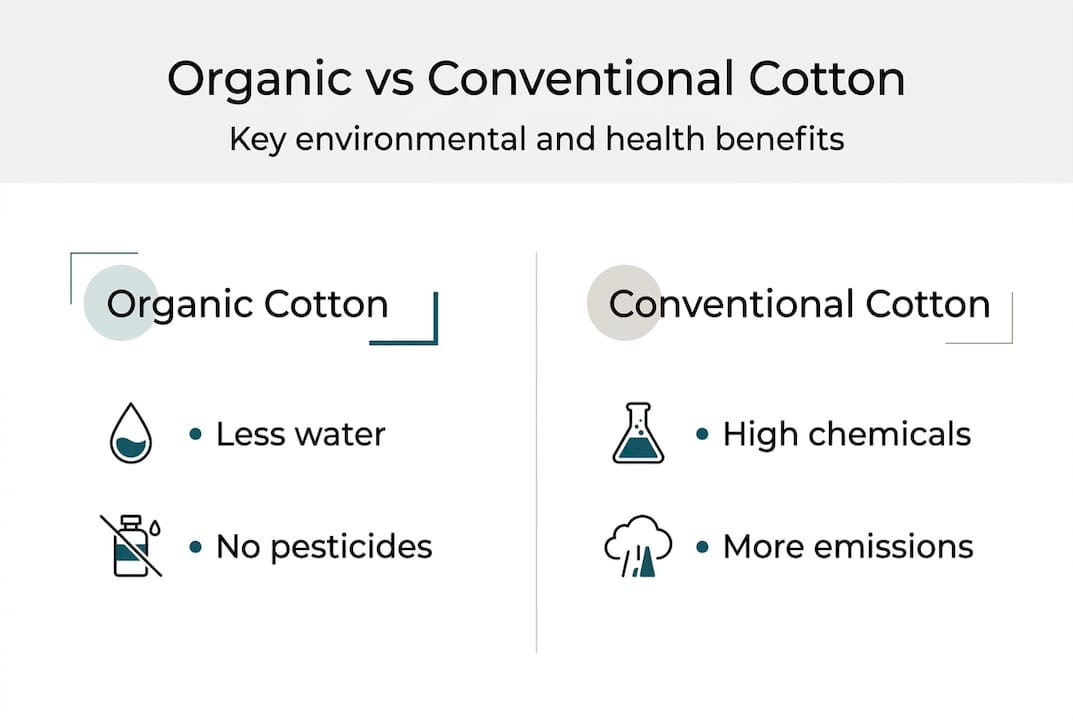
| Environmental factor | Organic cotton | Conventional cotton |
|---|---|---|
| Irrigation water use | Up to 91% less | High, often unsustainable |
| CO2 emissions per hectare | 45% lower | Baseline |
| Yield (Fairtrade system) | 598 kg/ha | 530 kg/ha |
| Synthetic pesticide use | Zero | High |
| Soil health | Improved via crop rotation | Depleted over time |
| Biodiversity impact | Positive | Negative |
One of the most persistent myths is that organic cotton yields less, making it impractical at scale. Organic yields are actually comparable or higher in certified Fairtrade systems, at 598 kg per hectare versus 530 kg for conventional. Crop rotation, which is required in organic farming, also rebuilds soil health and supports local biodiversity in ways that monoculture farming simply cannot.
The true cost of fast fashion includes polluted waterways, depleted aquifers, and degraded farmland. Organic apparel directly addresses all three. And when you pair it with eco-friendly garment care, the lifecycle impact drops even further. Sustainability in e-commerce is growing fast, and organic apparel is central to that shift.
Pro Tip: When a brand claims sustainability, ask for a life cycle assessment (LCA). An LCA measures environmental impact across the product’s full life, from raw material to disposal. Brands that publish LCA data are far more credible than those relying on vague “eco” language.
Health and safety for families
Conventional cotton clothing can carry residues from pesticides, formaldehyde-based wrinkle treatments, and azo dyes linked to skin irritation and allergic reactions. For adults with sensitive skin, this is uncomfortable. For babies and young children, it’s a real concern.

Organic apparel removes that risk at the source. GOTS certification bans over 100 chemical inputs, including known carcinogens and endocrine disruptors. Every stage of production is audited, so the finished garment your child wears has been verified clean from field to finished product.
Here’s what organic apparel means specifically for families:
- No synthetic pesticide residues on fabric that touches skin
- No toxic dyes or heavy metal-based colorants
- Softer texture due to gentler processing methods
- Lower risk of contact dermatitis or allergic reactions
- Safer for newborns and toddlers with underdeveloped immune systems
“Since switching to certified organic clothing for our daughter, her eczema flare-ups have dropped significantly. We didn’t realize how much the fabric itself was contributing until we made the change.”
For parents building a sustainable wardrobe essentials collection for their kids, organic certification isn’t a luxury. It’s a baseline for safety.
Ethics, fairness, and true cost comparisons
Organic apparel isn’t just about the environment or your family’s health. It’s also about the people who make your clothes. Conventional garment production is notorious for poverty wages, unsafe factories, and child labor in supply chains that are nearly impossible to trace.
GOTS requires fair wages and full social compliance at every certified facility. That means workers are paid fairly, factories meet safety standards, and no children are employed. This is verified, not self-reported. Fashion sustainability trends show that 60% of consumers now say ethical production influences their purchasing decisions.
| Factor | Organic certified apparel | Fast fashion / conventional |
|---|---|---|
| Price per item | Higher upfront | Lower upfront |
| Garment lifespan | 3 to 5+ years | Often under 1 year |
| Cost per wear | Lower over time | Higher over time |
| Chemical safety | Verified clean | Unverified |
| Labor standards | Audited and certified | Often opaque |
| Environmental cost | Significantly lower | High |
Yes, organic apparel costs more at the register. But when you calculate cost per wear, the math often favors organic. A well-made organic cotton shirt that lasts five years beats a cheap conventional one replaced three times in the same period, both financially and ecologically.
Pro Tip: Search a brand’s name plus “GOTS certificate” or “Fairtrade certificate” in a public database. Legitimate certifications are publicly listed. If you can’t find it, the claim isn’t verified. You can also review sustainability practices directly on a brand’s website to see how transparent they are about sourcing and production.
Caveats and real-world nuance: Is organic always best?
Organic apparel is genuinely better in most scenarios. But no single option is perfect in every context, and understanding the nuances makes your choices smarter.
Organic cotton can require more land in some regions compared to high-yield conventional farming, particularly where water is abundant and pest pressure is low. Recycled cotton, made from post-consumer textile waste, sometimes has a lower carbon footprint because it skips the agricultural phase entirely. But recycled cotton has its own trade-offs: fiber quality degrades with each recycling cycle, and chemical contamination from the original garment can carry over.
Here’s a practical framework for deciding:
- For children’s clothing: Prioritize GOTS organic. Chemical safety is the top concern.
- For outerwear and performance gear: Recycled nylon or polyester may have a lower impact, especially if durability is high.
- For basics and everyday wear: GOTS organic cotton is the most balanced choice across health, ethics, and environment.
- For secondhand options: A pre-owned conventional garment often beats a new organic one in terms of total resource use.
- For blended fabrics: Check the percentage of organic content and whether the blend is certified.
“The goal isn’t to find the perfect product. It’s to make consistently better choices. Organic certification is one of the most reliable tools we have for that.”
When building a sustainable wardrobe, think in terms of context rather than absolutes. For a deeper breakdown of fiber trade-offs, cotton comparison details offer a useful reference.
How to shop for organic apparel: Tips and action steps
Knowing the facts is one thing. Putting them into practice at the checkout is another. Here’s a step-by-step approach to shopping organic apparel with confidence.
- Look for GOTS or Fairtrade certification first. These are the two most rigorous and publicly verifiable standards. Both cover chemical safety, labor rights, and environmental impact.
- Verify the certificate independently. Don’t rely on the brand’s word. Search the GOTS public database at global-standard.org to confirm the certificate is current and covers the specific product line.
- Read the materials list. A GOTS-certified garment will list the fiber content and certification tier. “Made with organic materials” is weaker than “GOTS certified organic.”
- Ask about the supply chain. Transparent brands will tell you where their fabric is grown, where it’s processed, and where it’s sewn. Vague answers are a red flag.
- Use LCA data when available. GOTS verifies full chain-of-custody and LCAs benchmark real-world environmental impact. Brands that publish this data are serious about accountability.
- Prioritize longevity over novelty. Buy fewer, better pieces. A certified organic garment worn 200 times has a fraction of the per-wear impact of a trendy piece worn five times.
- Check brand transparency pages. Brands committed to sustainability will publish their sourcing, certifications, and production standards openly. See how we ensure sustainability as an example of what genuine transparency looks like.
Shopping organic doesn’t require a complete wardrobe overhaul overnight. Start with the items closest to your skin, like underwear, t-shirts, and children’s basics, and build from there.
Eco-friendly style starts with you
You now have the data, the framework, and the tools to shop organic apparel with real confidence. The next step is finding a brand that matches those standards in practice, not just in marketing copy.

At M23, every piece is designed with verified organic and recycled materials, produced under fair conditions in Berlin and Poland. The sustainability commitment page lays out exactly how sourcing, production, and certifications work, no vague claims. If you want to understand exactly what goes into each garment, what’s in our apparel gives you a full breakdown of every material used. Making planet-positive choices doesn’t mean compromising on quality or style. It means knowing what you’re buying and why it matters.
Frequently asked questions
What does GOTS certified actually mean for clothing?
GOTS certification means clothing meets strict organic, chemical, and labor standards, verified at every stage from field to finished product. It’s the most rigorous textile certification available globally.
Is organic cotton really better for the environment?
Yes. Organic cotton uses 91% less water and produces 45% fewer CO2 emissions per hectare, while also improving soil health and supporting biodiversity compared to conventional cotton.
How can I avoid greenwashing when shopping organic apparel?
Check for credible certifications like GOTS and Fairtrade in public databases, and look for brands that publish full supply chain transparency. GOTS verifies chain-of-custody so you can confirm any claim independently.
Are there trade-offs with organic apparel?
In some cases, organic can require more land than high-yield conventional farming, and recycled cotton sometimes has a lower carbon footprint. Overall, organic is safer for people and better for long-term soil and water health.