

Why sustainable sourcing matters in fashion: impact & tips
TL;DR:
- Sustainable sourcing considers environmental impact, labor rights, and resource preservation throughout production.
- Certifications like GOTS, OEKO-TEX, and EU Ecolabel help verify genuine sustainable practices.
- Greenwashing is common; shoppers should look for transparency, third-party verification, and detailed supply chain info.
Buying an item labeled “eco-friendly” feels like the right move. But here’s what most shoppers don’t realize: that label often tells only a fraction of the story. Fashion accounts for 2-8% of global carbon emissions and roughly 20% of all clean water pollution worldwide. That means the choices we make go far deeper than the fabric on the tag. This article breaks down what sustainable sourcing actually means, why it drives real environmental change, and how you can read between the lines to find clothing that genuinely holds up to scrutiny.
Table of Contents
- Understanding sustainable sourcing in fashion
- How sustainable sourcing reduces environmental impact
- Key certifications and methodologies for sustainable sourcing
- The pitfalls: Greenwashing and ethical trade-offs
- Why holistic sourcing matters more than any single label
- Ready to shop responsibly? Explore sustainable collections
- Frequently asked questions
Key Takeaways
| Point | Details |
|---|---|
| Sourcing drives impact | How and where your clothes are made has a major effect on pollution and resource use. |
| Look for certifications | Trusted certifications like GOTS and EU Ecolabel identify lower-impact apparel but always check what they actually cover. |
| Beware greenwashing | Some brands overstate their eco-claims, so demand transparency and credible verification. |
| Choose holistic solutions | Combine certifications with supply chain transparency for the most responsible shopping. |
Understanding sustainable sourcing in fashion
Sustainable sourcing is not just about choosing organic cotton over conventional. It’s the full system of decisions a brand makes before a single stitch is sewn. Think of it as the blueprint that governs where materials come from, how workers are treated, how water and energy are used, and what happens to waste at every step.
At its core, sustainable sourcing rests on three pillars:
- Environmental impact: Minimizing pollution, water use, and carbon emissions throughout production
- Labor rights: Ensuring fair wages, safe conditions, and ethical treatment across the entire supply chain
- Resource preservation: Favoring closed-loop or circular systems where materials are reused or recycled rather than discarded
A common misconception is that “eco” automatically means “ethical.” A garment can use organic fabric but still be sewn in a factory with poor labor standards. Conversely, a brand might treat its workers brilliantly but source materials through highly polluting processes. True sustainable sourcing addresses both dimensions simultaneously.
“Truly responsible fashion isn’t just about what a garment is made of. It’s about every decision made along the way.”
Why does sourcing matter more than materials alone? Because materials are just one node in a much longer chain. Sustainable sourcing reduces water use, carbon emissions, and pollution across the entire production process, not just at the point of harvest. A brand committed to sourcing responsibly will audit its suppliers, require third-party verification, and publish that information for shoppers to review.
For a broader grounding in what this looks like in practice, our sustainable fashion guide walks through the principles brands like ours apply from design to delivery. If you want to dig into specific materials, the breakdown of green textiles explained covers which fabrics genuinely reduce impact and why.
The shift in thinking is simple but powerful: stop asking only “what is this made of?” and start asking “how and where was every part of this made, and by whom?”
How sustainable sourcing reduces environmental impact
Now let’s get specific. The fashion industry’s environmental footprint is not abstract. Textiles are responsible for 2-8% of global CO2, and each EU citizen generates roughly 355 kg of CO2 per year from clothing alone. Those numbers reflect real consequences: melting ice, disrupted ecosystems, and communities living near polluted waterways.
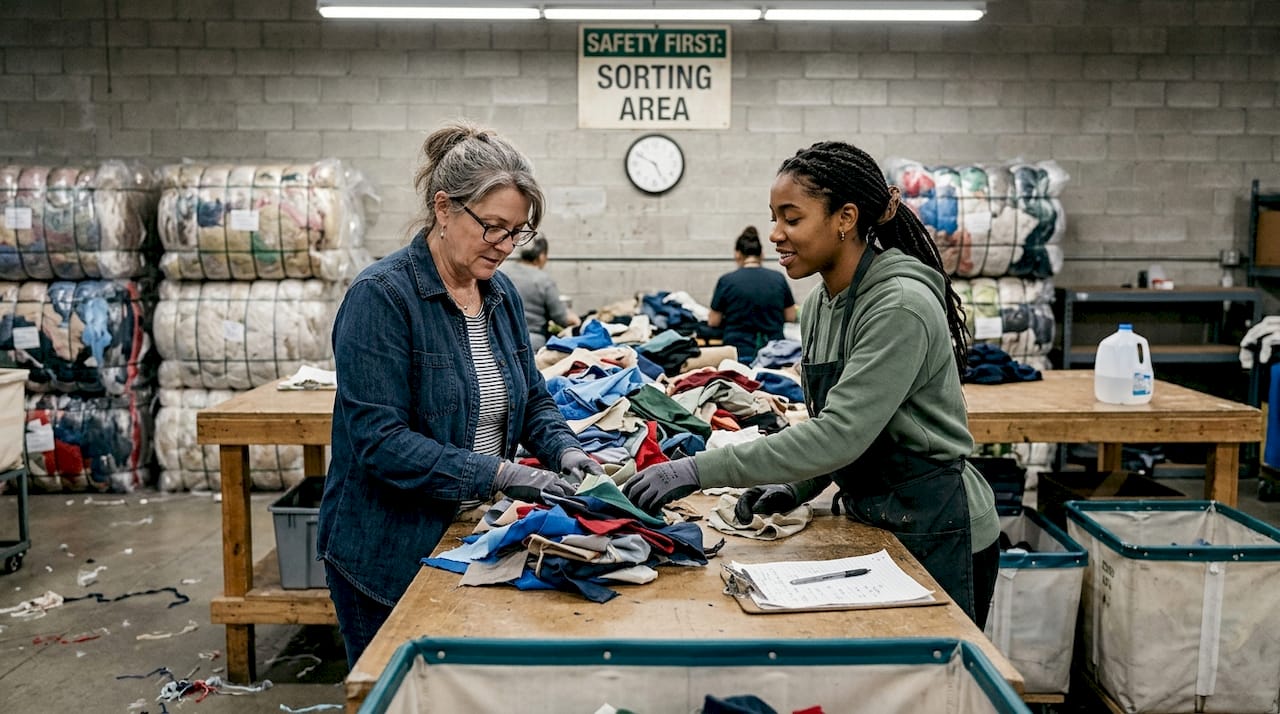
Sustainable sourcing attacks those numbers at multiple points in the production chain. Here’s how the outcomes compare:
| Environmental factor | Conventional fashion | Sustainably sourced fashion |
|---|---|---|
| Water consumption | Extremely high (cotton needs ~10,000L per kg) | Reduced through water-efficient crops and closed-loop dyeing |
| CO2 emissions | High from synthetic production and transport | Lowered via renewable energy and shorter supply chains |
| Chemical pollution | Heavy use of dyes and finishing agents | Restricted by certified non-toxic processes |
| Waste volume | Up to 85% of textiles end in landfills | Circular design reduces end-of-life waste |
Recovery and recycling are just as important as cutting initial resource use. A garment made from certified recycled nylon, for example, diverts plastic waste from oceans while requiring far less energy than producing virgin nylon. That’s a double win that purely “natural” fibers often can’t match.
“Reducing impact is not a single act. It’s a continuous cycle of smarter choices at every production stage.”
Pro Tip: Don’t stop at the word “organic.” Some naturally grown fibers, particularly conventional cotton, can still consume enormous quantities of water. Always look for specific data on water use, dye processes, and end-of-life options before assuming a product is low-impact. Our guide to eco-friendly fabric choices breaks down which materials actually perform better across multiple environmental dimensions.
The bottom line: sustainable sourcing doesn’t just reduce harm. It creates a fundamentally different kind of production system, one where environmental cost is tracked, minimized, and communicated honestly.
Key certifications and methodologies for sustainable sourcing
Knowing what sustainable sourcing should look like is one thing. Knowing how to spot it on a label is another. Certifications exist to bridge that gap, but not all of them carry equal weight.
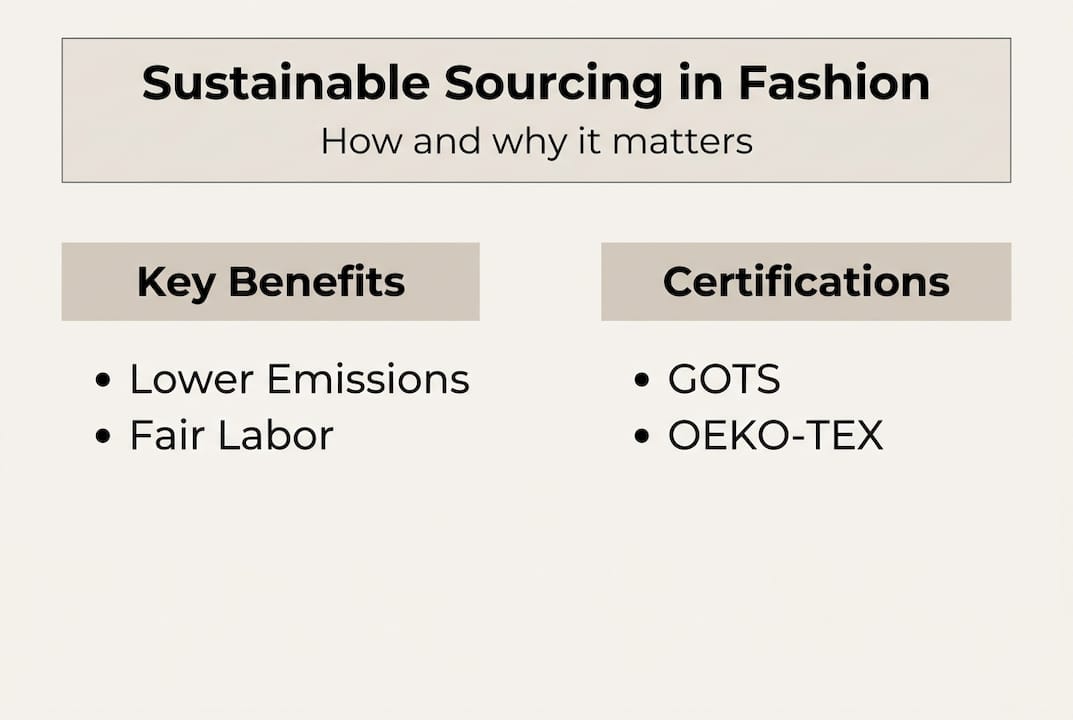
Here’s a quick comparison of the most widely recognized labels in European sustainable fashion:
| Certification | What it covers | Strength |
|---|---|---|
| GOTS (Global Organic Textile Standard) | Organic fiber content, safe processing, fair labor | Strong on both environment and social standards |
| OEKO-TEX Standard 100 | Tests for harmful substances in finished product | Strong on consumer safety; less on labor |
| EU Ecolabel | Full product lifecycle impact | Covers top 10-20% lowest impact products across the market |
| Better Cotton Initiative | Sustainable cotton farming practices | Field-level improvement; less strict on full chain |
| FSC/PEFC | Responsible forest management for viscose/lyocell | Important for wood-based fiber transparency |
When reading a label, keep this checklist in mind:
- Is the certification issued by a recognized third-party organization?
- Does it cover the full lifecycle or just one stage?
- Can you verify the claim on the certifying body’s website?
- Does the brand publish supplier names or factory audit results?
Certifications matter, but supply chain transparency matters just as much. A brand can hold a respected certification and still obscure where its subcontractors operate. Learning how to choose recycled apparel ethically means going beyond the logo on the tag. And if you want to understand the broader values behind responsible production, what makes fashion ethical covers the principles that separate genuine commitment from marketing language.
The goal is to use certifications as a starting point, not an endpoint. A label is a signal, not a guarantee.
The pitfalls: Greenwashing and ethical trade-offs
Even careful shoppers get misled. Greenwashing is the practice of making a product appear more sustainable than it really is. It’s widespread, and it’s getting more sophisticated.
Here are the most common red flags to watch for:
- Vague language: Terms like “eco-conscious,” “green,” or “responsible” without any certification or data to back them up
- Cherry-picked claims: Highlighting one sustainable attribute (like packaging) while ignoring the rest of the supply chain
- Incomplete certification: Displaying a logo that only covers raw materials, not processing or labor conditions
- No verifiable source: Claims that can’t be checked against a public database or third-party audit
- Overstated impact: Phrases like “saves the planet” or “100% sustainable” that no single garment can genuinely support
Luxury fashion is not immune. Some brands only meet half their sustainability commitments while labor exploitation in lower tiers of their supply chains goes unaddressed. High price does not equal high ethics.
There are also real trade-offs that honest brands acknowledge. Organic cotton, for example, avoids synthetic pesticides but can use more water than some conventional or recycled alternatives depending on the region and farming method. A brand that only talks about the positives and never names the trade-offs is probably not being fully transparent.
Pro Tip: Ask brands directly. A transparent company will point you to factory lists, audit reports, and material data sheets. If the answer is silence or marketing language, that’s your answer. Our look at spotting greenwashing in fashion walks through exactly how to do this in practice.
Shopping smarter doesn’t mean being cynical. It means being curious and holding brands to account with the right questions.
Why holistic sourcing matters more than any single label
Here’s the uncomfortable truth we’ve come to understand from building sustainable collections from the ground up: no single certification ever tells the whole story. Not GOTS. Not the EU Ecolabel. Not OEKO-TEX. Each one is a window into part of the picture, never the whole room.
Experts urge a shift toward preferred production systems that look at the entire lifecycle rather than fixating on any one material or stamp of approval. We agree completely. What actually moves the needle is whether a brand has embedded responsibility into its supply chain structure, not just its marketing materials.
At M23, this thinking shapes how we work with our production partners in Berlin and Poland. We ask for evidence, not assurances. We look at labor audits, energy sourcing, waste management, and water treatment. And we communicate trade-offs openly because you deserve that honesty. The brands worth trusting are the ones that tell you what they haven’t figured out yet, right alongside what they have. For a deeper look at the principles guiding this approach, see our piece on principles of ethical apparel.
Ready to shop responsibly? Explore sustainable collections
Understanding sustainable sourcing gives you real power as a shopper. You now know what to look for, what to question, and how to read the signals that separate genuine commitment from clever marketing.

The next step is finding a brand that holds itself to those same standards. At M23, every collection is built around certified materials, fair labor partnerships, and honest reporting. Whether you’re browsing women’s wear, men’s essentials, or children’s apparel, you’ll find sourcing details and material data to help you decide with confidence. Sustainable fashion doesn’t have to be complicated when the brand does the work of transparency for you.
Frequently asked questions
What is the most trusted certification for sustainable fashion?
GOTS, OEKO-TEX, and EU Ecolabel are widely respected, but EU Ecolabel ranks among the strongest because it evaluates environmental impact across the full product lifecycle rather than a single production stage.
How can I tell if a brand is greenwashing?
Look for vague claims without third-party verification and a lack of supply chain transparency. Brands often meet only half of their stated sustainability commitments, so always look for auditable evidence.
Does organic cotton always mean more sustainable?
Not necessarily. Organic cotton can require more water than some alternatives depending on farming methods, so always check full resource use data before assuming it’s the lowest-impact choice.
What impact does the fashion industry have on water pollution?
Fashion causes roughly 20% of global clean water pollution, largely from dyeing and finishing processes that release chemicals into waterways near production facilities.